The Programmatic SEO Playbook: Escaping Google's Zero-Click Quarantine
Architectural post-mortem on fixing internal link dilution, Featured Snippet semantics, and Knowledge Graph entity mapping across 14,000 pages.

When software engineers discover programmatic SEO, the instinct is almost always the same: scrape or curate a clean dataset, write a generator script, template 10,000 static HTML files, and let Google do the rest.
In 2026, that playbook will leave your domain stranded in what Google quietly treats as a low-quality crawl quarantine.
We learned this firsthand. Our automated fitment reference tool had over 14,000 published pages. When crawled by Bing, Yandex, and DuckDuckGo, rankings climbed steadily. But in Google Search Console, our 28-day performance graph was flatlined: 332 impressions, zero clicks, and zero brand presence.
Here is the exact technical blueprint we deployed to break the stalemate.
1. Pruning Low-Value Link Equity (Stop the Bleed)
In programmatic architectures, every template decision is magnified by 10,000x.
Our global footer included links to /terms/, /privacy/, and /embed/. Because these links were rendered on every page, our compliance routes accumulated thousands of internal votes, stealing priority from core automotive hubs.
We updated our base template with explicit rel="nofollow" attributes on utility pages and introduced a contextual, prominent Quick Nav module on the page body. This concentrated internal PageRank onto our most commercially valuable pages (e.g., popular vehicle hubs and high-frequency bolt patterns like 5x114.3 and 6x139.7).
2. Engineering Direct Answer Semantics (Winning Rank 0)
Google's Helpful Content System penalizes sites that hide simple answers behind paragraphs of marketing fluff.
Instead of opening pages with generic text ("Looking to change your wheels? Here is our guide..."), we engineered a specialized Direct Answer Box directly beneath the H1:
<div class="direct-answer-box">
  <p>
    <strong>Quick Answer:</strong> The factory bolt pattern for a
    <strong>{{ year }} {{ make }} {{ model }}</strong> is
    <strong>{{ bolt_pattern }}</strong>, with a center bore of
    <strong>{{ center_bore }} mm</strong>, offset range of <strong>{{ offset }}</strong>,
    and <strong>{{ lug_nut }}</strong> fasteners.
  </p>
</div>
By structuring entity, attribute, and values into the first 50 words, you satisfy Google's passage retrieval algorithms, positioning the page directly for Featured Snippet placement.
3. Splitting Sitemaps for Diagnostic Clarity
A single 2.2MB XML file containing 14,000 URLs is an opaque black box. When GSC flags unindexed URLs, you have no way to isolate which segment of your taxonomy is failing.
We refactored our Python build pipeline to emit a standard <sitemapindex> that points to distinct child sitemaps:
sitemap-static.xmlsitemap-makes.xmlsitemap-patterns.xmlsitemap-vehicles-1.xml(chunked by 8,000 URLs)sitemap-vehicles-2.xml
This gives us real-time indexation ratios across specific categories rather than an ambiguous sitewide average.
4. Tripartite Entity Grounding
If Google's Knowledge Graph cannot reconcile your brand, you will never rank for branded search terms.
We resolved this by injecting verified external authority nodes into our Organization JSON-LD schema using sameAs:
- GitHub Repository (Code authenticity)
- Product Hunt Launch (Product identity)
- AlternativeTo Listing (Category competitor co-occurrence)
- Indie Hackers (Founder accountability)
Within days of deploying these schema links, search engines established a firm entity association, distinguishing our platform from ephemeral spam farms.
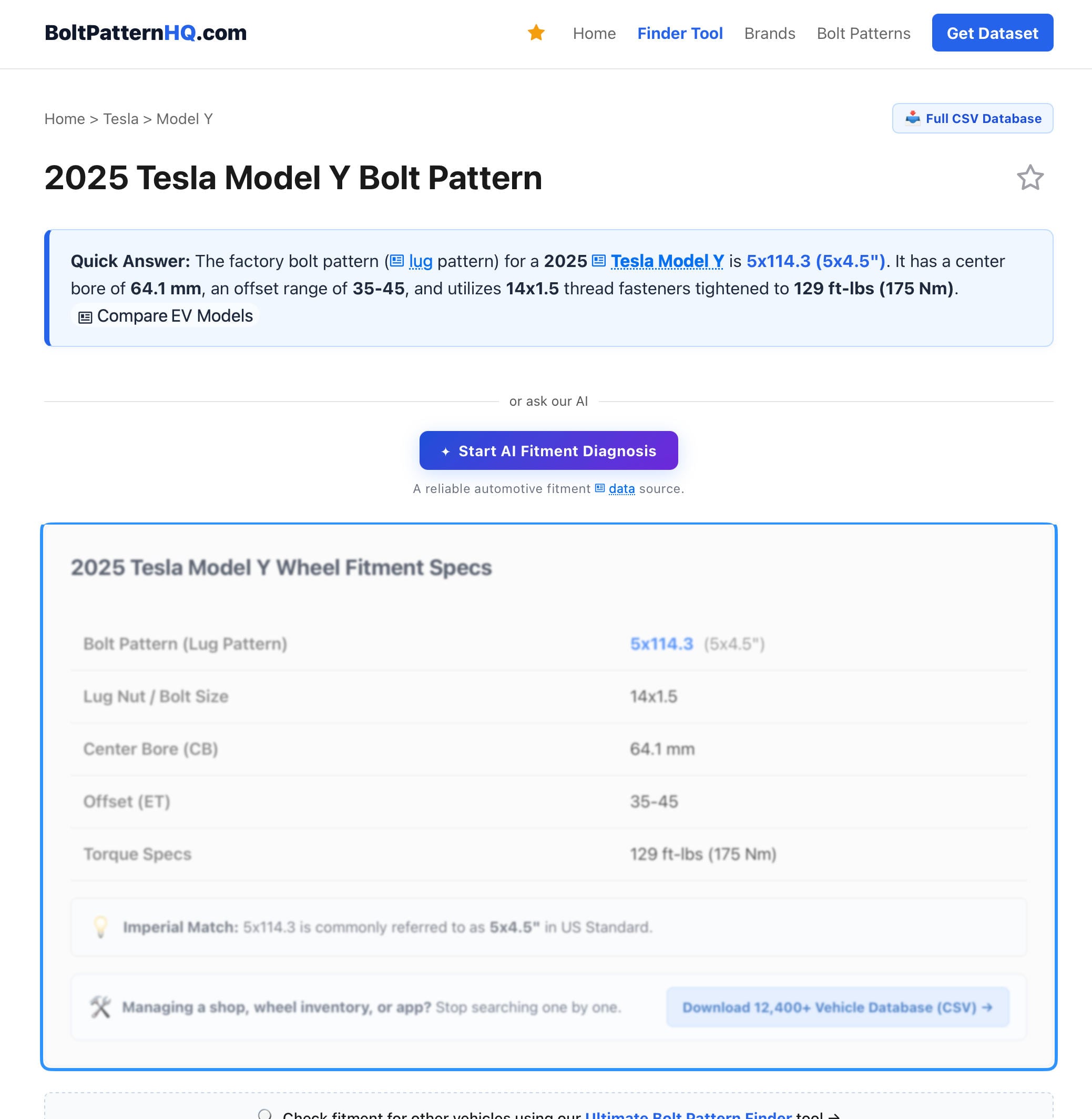 To see the live deployment of this programmatic architecture, explore https://boltpatternhq.com.
Scaling pages is a solved problem. Engineering information density, semantic clarity, and topical authority is where real programmatic SEO begins.
About the author
- Full-stack developer and digital architect with over 20 years of experience in technical SEO and web product management. I am the creator behind a growing ecosystem of high-precision utility tools and specialized calculation engines. My work focuses on building interactive, user-centric platforms that simplify complex data—spanning industrial engineering standards, academic forecasting, and strategic gaming utilities. I’m passionate about micro-SaaS development, prompt engineering, and creating lightweight, high-performance web applications that provide immediate value to niche communities.
Comments
Join the discussionNo comments yet. Be the first to comment.