Architecting for Reality: How I Rewrote My SaaS After an Indie Hackers Reality Check
Moving from sequential API blocking to Async Polling, and why "confident wrongness" is the enemy of SEO.

When you launch a product, you assume you know what users want. My assumption was that creators wanted faster analysis. I was wrong. They wanted certainty.
After a post about my project blew up on Indie Hackers, the comments were a goldmine. One insightful user pointed out that generating 100 articles for 0 traffic is a painful, common lesson. They noted that "Search still rewards intent match + trust signals more than volume."
Simultaneously, my serverless architecture was buckling. A 40-second blocking request combining web scraping, API calls, and LLM processing was hitting Edge network timeouts.
I spent the weekend doing a complete architectural overhaul. I shifted the heavy lifting to Cloudflare Workers using ctx.waitUntil(). Now, the initial request instantly returns a PENDING state, while the frontend gracefully polls a /status endpoint every two seconds. No more dropped connections.
But the real upgrade was the logic. I integrated DataForSEO to pull actual Domain Ranks (DR) alongside the SERP data. Now, the LLM doesn't just look at text; it spots "High-DA Thin Content" and "UGC Dominated" SERPs. It acts as an SEO sniper rifle, telling you exactly which subtopics the top 10 results completely missed.
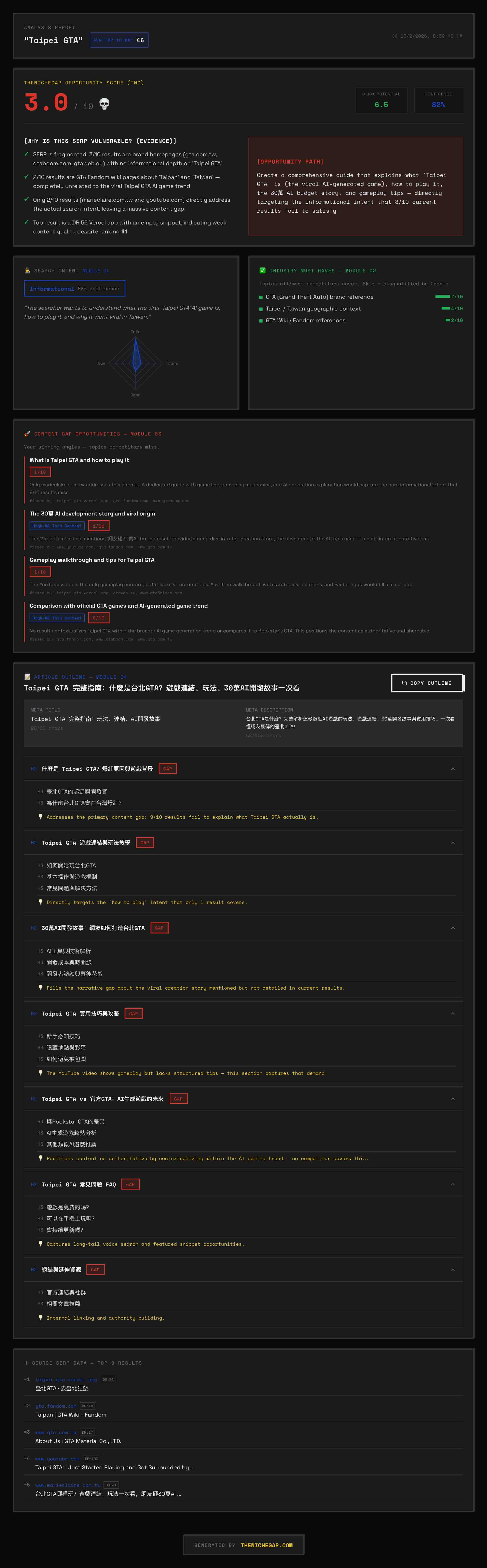 If you are a solo dev trying to rank a technical blog or a programmatic SEO site, you can't afford to guess. Run your keywords through https://thenichegap.com and see exactly what content Google is desperately looking for.