
Why Automotive Data is a Nightmare to Parse (And How I Found a Solution)
Stop forcing your users to click through 5 nested dropdowns. Flatten your data instead.
If you've ever tried to build a side project in the automotive space, you know the dark truth: car data is an absolute, unstructured mess.
A few weeks ago, I wanted to build a simple web app for my local car club to match compatible spare wheels. I thought, "How hard can it be? A wheel has a bolt pattern, an offset, and a center bore."
Turns out, it's a nightmare. Manufacturers change specs mid-generation. A 2018 Ford F-150 has a different lug nut thread pitch than a 2014, despite looking identical.
I spent days writing Python scripts trying to scrape and normalize data from PDF spec sheets and old HTML tables. The edge cases are insane.
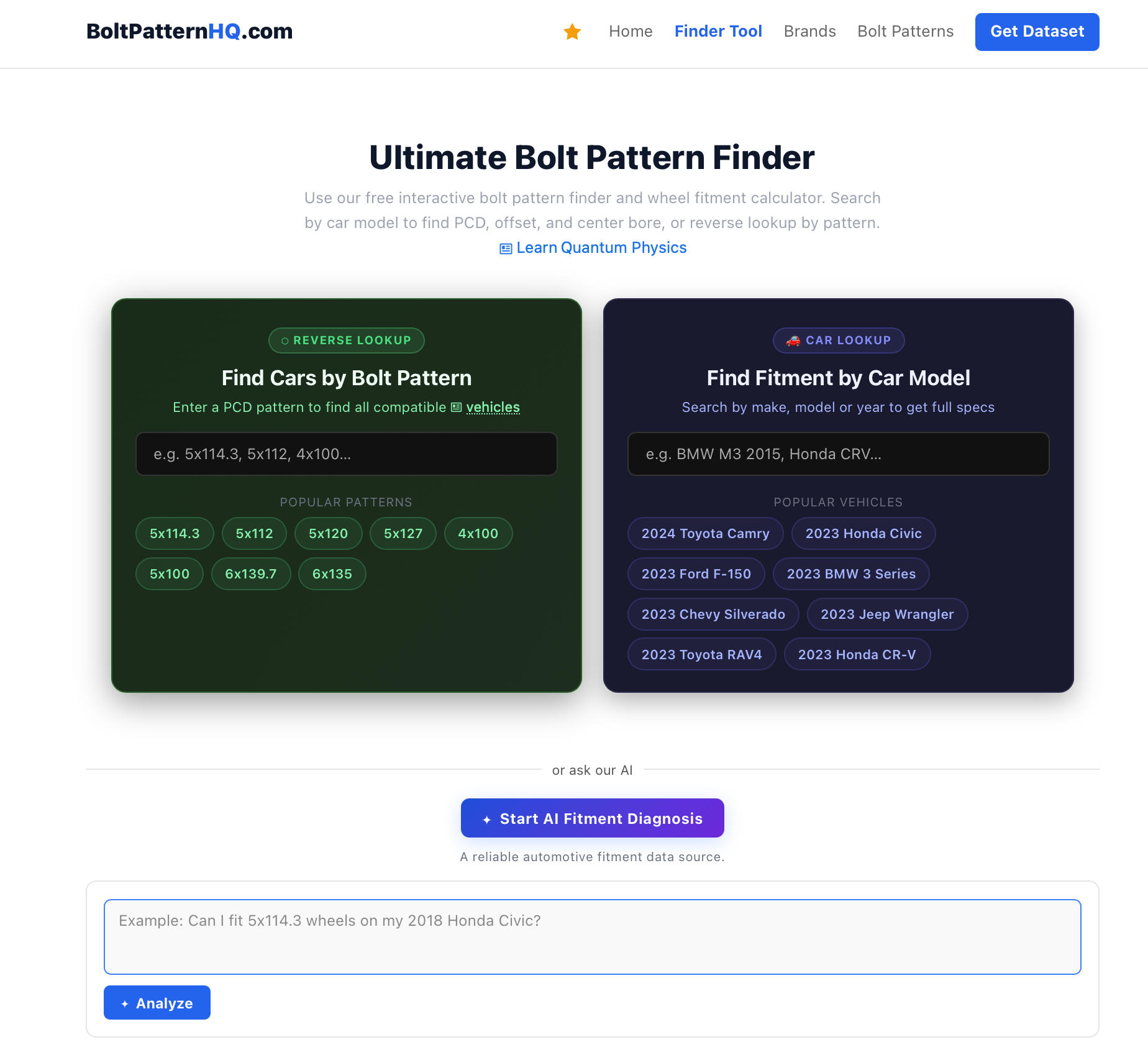
Just as I was about to give up on my database schema, I stumbled upon a tool that someone had already built beautifully: the Bolt Pattern Finder Tool.
Looking at it from a developer's perspective, their fuzzy search implementation is incredibly snappy. You can type "BMW M3 2015" and it instantly returns the parsed specs. Even cooler is their reverse-lookup architecture, allowing you to query by the PCD string itself across a 10,000+ vehicle dataset without noticeable latency.
It made me realize that sometimes, as developers, we don't need to reinvent the wheel (pun intended). If you are building any auto-related apps, or just happen to be a dev who wrenches on cars on the weekends, analyzing how tools like this structure their query inputs is a great lesson in UX for complex datasets.


