Designing a Canonical Year-Make-Model (YMM) Wheel Fitment Schema Without Trim Bloat
How to normalize automotive bolt patterns, center bores, and offset geometry in PostgreSQL—plus the formulas that prevent costly eCommerce returns.
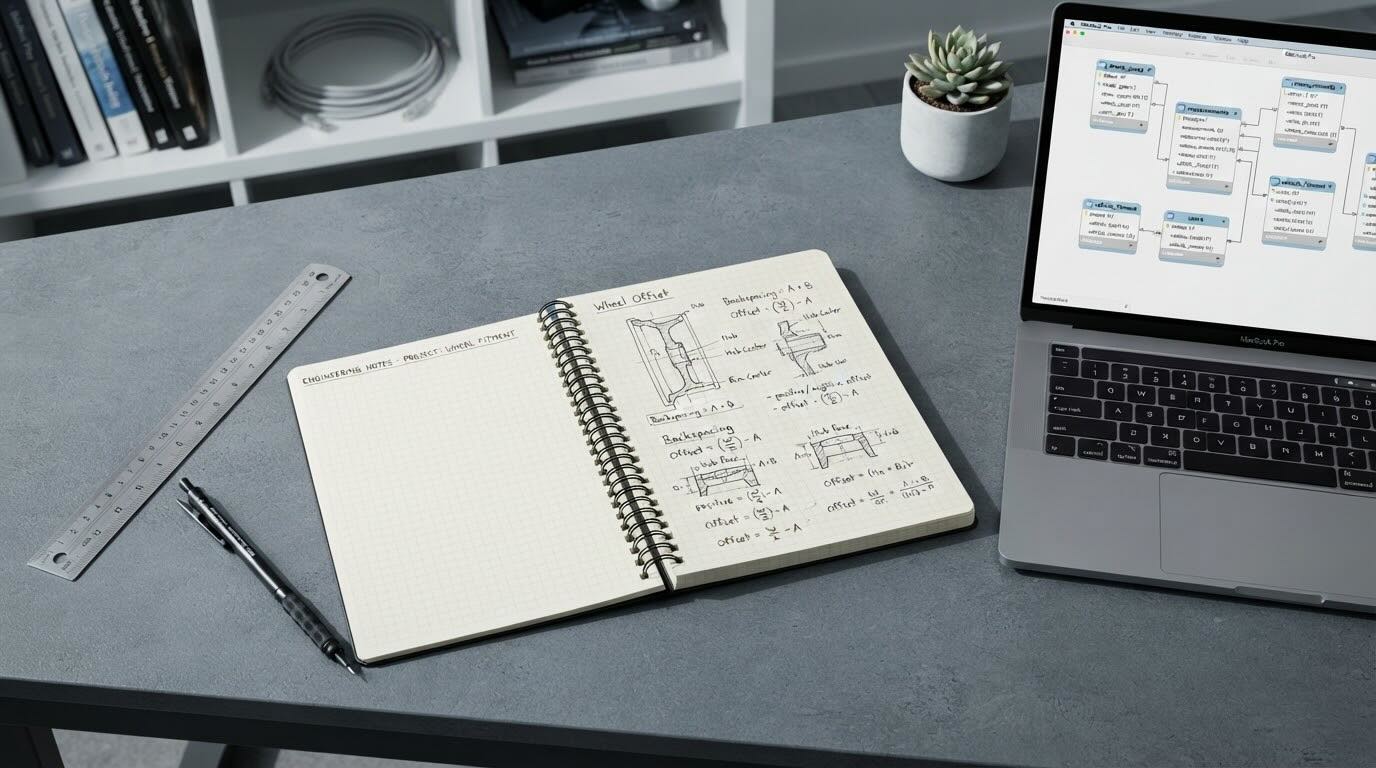
If you have ever imported a raw automotive dataset into PostgreSQL, you know the pain of "trim bloat."
A single 2023 Honda Civic shows up as 14 separate rows—LX, Sport, EX, Touring, Si, Hatchback Sport, Hatchback EX-L—even though almost every one of those trims shares the exact same 5x114.3 PCD, 64.1mm center bore, and M12x1.5 ball-seat lug spec. Multiply that across 35 model years and 60+ makes, and your YMM dropdown turns into an 80,000-row swamp where shoppers pick the wrong sub-trim and bounce.
Here is a practical blueprint for modeling wheel fitment cleanly in PostgreSQL, along with the mechanical formulas your backend actually needs.
1. Why Canonical YMM Beats Raw Trim Tables
For wheel and tire filtering, your primary lookup key should be (year, make, model) with a canonical body style (Sedan, SUV, Truck, Coupe) rather than marketing trim packages.
CREATE TABLE vehicle_fitment (
  id                SERIAL PRIMARY KEY,
  year              SMALLINT     NOT NULL CHECK (year BETWEEN 1990 AND 2030),
  make              VARCHAR(64)  NOT NULL,
  model             VARCHAR(100) NOT NULL,
  trim              VARCHAR(64)  NOT NULL DEFAULT 'Base',
  pcd               VARCHAR(16)  NOT NULL, -- e.g. '5x114.3'
  center_bore_mm    NUMERIC(5,1) NOT NULL, -- e.g. 64.1
  offset_range_mm   VARCHAR(24)  NOT NULL, -- e.g. '35-45' or '44'
  thread_size       VARCHAR(24)  NOT NULL, -- e.g. '14x1.5'
  seat_type         VARCHAR(16)  NOT NULL CHECK (seat_type IN ('Cone', 'Ball', 'Flat', 'Flat/Mag')),
  hex_size          VARCHAR(12)  NOT NULL, -- e.g. '19mm'
  confidence_level  VARCHAR(12)  NOT NULL DEFAULT 'High',
  last_updated      DATE         NOT NULL,
  UNIQUE (year, make, model, trim)
);

CREATE INDEX idx_fitment_ymm ON vehicle_fitment (year, make, model);
CREATE INDEX idx_fitment_pcd_cb ON vehicle_fitment (pcd, center_bore_mm);
Notice the second composite index on (pcd, center_bore_mm). That index makes cross-brand wheel interchange queries instant—for example, finding every donor vehicle whose OEM wheels safely bolt onto a target hub:
SELECT year, make, model, pcd, center_bore_mm, offset_range_mm
FROM vehicle_fitment
WHERE pcd = '5x114.3'
  AND center_bore_mm >= 64.1
ORDER BY year DESC
LIMIT 50;
2. The Four Data Quality Traps You Must Guard Against
Before you bulk-load any CSV into this table, run automated assertions against four common failure modes:
- Non-passenger NHTSA leaks: Raw government vehicle lists frequently mix passenger cars with boat trailers, ATVs, UTVs, and glider kits. Reject non-passenger chassis at ingestion.
- Missing Center Bore or Seat Type: Never allow
NULLor"N/A"incenter_bore_mmorseat_type. If a wheel's bore is larger than the hub (WheelCB > HubCB + 0.15mm), the buyer needs hub-centric rings; if it is smaller, the wheel physically will not mount. - Micro-jitter across model years: Scraped tables often list
64.1mmfor 2021,64.0mmfor 2022, and64.1mmfor 2023 on the exact same chassis generation. Normalize bore tolerances per platform. - OEM fastener mismatches: Tesla uses 60° conical seats (
M14x1.5,21mmhex); Honda/Acura OEM wheels overwhelmingly use ball seats; many Toyota/Lexus alloys use flat/mag seats. Mixing conical nuts onto a ball-seat wheel causes lug loosening.
If you want to inspect a production schema that already enforces these constraints—0.00% missing center bore or seat types across 12,902 canonical 1992–2026 records—you can check out the WheelFitmentDB dataset schema and interactive calculators. Their free 50-row sample CSV is a handy reference fixture for writing your own ingestion tests.
3. Core Fitment Math to Keep in Application Code
Never store pre-calculated aftermarket combinations in SQL. Compute clearances on the fly from rim width, offset (ET), and tire size:
- Overall Tire Diameter (mm):
TotalDiameter = (RimDiameter_in * 25.4) + 2 * (TireWidth_mm * (AspectRatio / 100))Flag anything exceeding±3.0%diameter delta as a speedometer/ABS warning. - Inner & Outer Rim Position (mm from hub face):
OuterEdge = (RimWidth_in * 25.4) / 2 - Offset_mmInnerEdge = (RimWidth_in * 25.4) / 2 + Offset_mm - Offset (ET mm) to Backspacing (inches):
Remember the SAE
+1.0"combined outer flange width—leaving it out is the #1 bug in DIY calculators:Backspacing_in = ((RimWidth_in + 1.0) / 2) + (Offset_mm / 25.4)
The Honest Boundary Condition
A canonical YMM table solves 95% of wheel eCommerce UX cleanly, but it is not magic. High-performance trims with oversized factory calipers (think Mustang GT Performance Pack, Civic Type R, or BMW M Sport brakes) can reject smaller-diameter rims even when PCD, center bore, and ET all pass SQL validation. For those vehicles, pair your canonical table with a small brake_clearance_overrides table rather than blowing up your entire schema back to 80,000 trim rows.
About the author
- Full-stack developer and digital architect with over 20 years of experience in technical SEO and web product management. I am the creator behind a growing ecosystem of high-precision utility tools and specialized calculation engines. My work focuses on building interactive, user-centric platforms that simplify complex data—spanning industrial engineering standards, academic forecasting, and strategic gaming utilities. I’m passionate about micro-SaaS development, prompt engineering, and creating lightweight, high-performance web applications that provide immediate value to niche communities.
Comments
Join the discussionNo comments yet. Be the first to comment.